
Pause Ads and Self-Serve CTV: How to Launch Connected TV Campaigns Without an Agency
Pause Ads on HBO Max and discovery+ open new CTV opportunities: a practical guide to launching a self-serve CTV advertising campaign with no minimum spend.
Contents
- Pause Ads: the news reshaping the CTV landscape
- What is a CTV DSP, and why do you need one to buy Pause Ads and streaming inventory?
- The strategic advantages of programmatic CTV
- How to get started with CTV and a DSP: the step-by-step guide
- Self-serve CTV platform barriers (and how a DSP removes them)
- Self-serve CTV with ad:personam: no agency, no minimum spend
- Conclusion
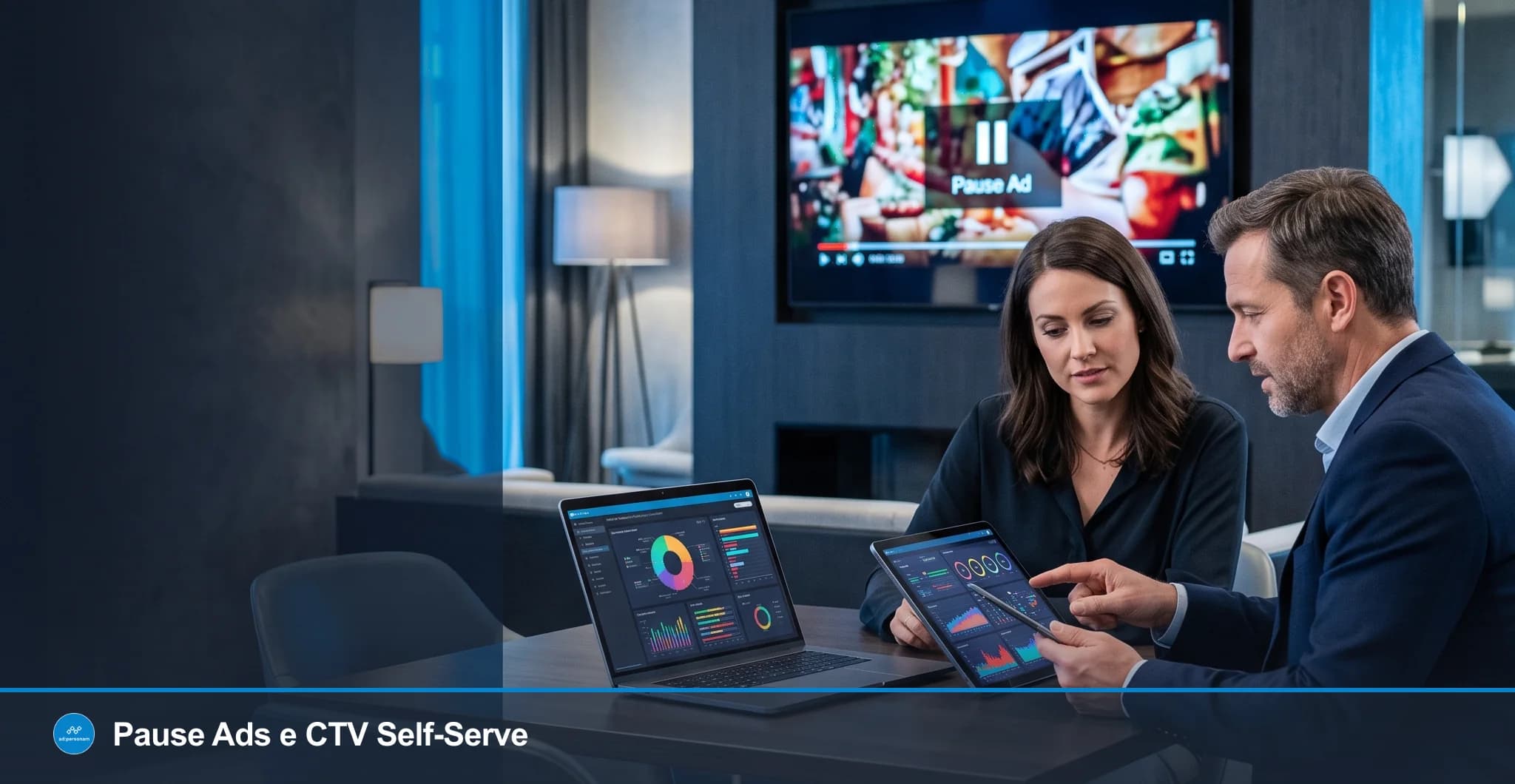
Connected TV (CTV) keeps expanding, and it's doing so with ad formats that are more interactive and less intrusive than ever. The latest development comes from The Trade Desk, which has broadened its CTV offering by introducing Pause Ads on HBO Max and discovery+: ads that appear the moment a viewer pauses a piece of content, without interrupting the viewing experience.
For anyone running self-serve CTV advertising, this isn't just industry trivia. It's confirmation that major streaming publishers are opening up more and more inventory to flexible, measurable programmatic buying—accessible not only to big brands with primetime budgets, but also to SMBs and independent agencies. In this article, we look at what's changing, how buying CTV inventory through a CTV DSP actually works, and how to set up your first campaign step by step.
Pause Ads: the news reshaping the CTV landscape
The Pause Ads format taps into a moment of natural attention: the viewer's own decision to pause. Unlike a classic pre-roll or mid-roll, it doesn't interrupt the program—it overlays the pause screen, delivering high visual impact with a lower perceived level of intrusiveness. For brands, that means a high-visibility placement in a context where the viewer is already focused on the screen, with strong odds of message recall.
This development arrives at a moment of sustained growth for Connected TV. As we covered in our analysis of programmatic advertising trends in Italy, CTV penetration in the Italian market has grown by more than 38% in two years, according to Magnite data, and more and more advertisers are folding it into omnichannel strategies alongside video, audio, and display. If you want a complete primer on what CTV is and how it works first, our complete connected TV advertising guide remains the best starting point; here, we focus on how to actually launch a campaign.
What is a CTV DSP, and why do you need one to buy Pause Ads and streaming inventory?
A CTV DSP (Demand-Side Platform for Connected TV) is a connected TV advertising platform that lets you buy ad space on smart TVs, consoles, media hubs, and streaming apps through real-time auctions, using the same data-driven approach as display advertising. Without a DSP, the only way to buy CTV would be direct negotiation with each individual publisher—typically involving high minimum spends and slow processes, the standard route for OTT platforms like Netflix, Prime Video, or local streaming apps.
With a self-serve DSP you can instead manage targeting, budget, and creative yourself, with no need to go through an agency or a dedicated account manager. That's the difference between buying CTV "the old way" and buying CTV programmatically: the same premium inventory, but with direct, scalable access.
The strategic advantages of programmatic CTV
Precision targeting on every device
A CTV DSP lets you segment audiences by geography, time of day, interests, and behavior, and lets you choose exactly which devices your ad appears on: smart TVs, consoles, media hubs, or streaming sticks. That level of control simply doesn't exist in linear TV, where program and time slot remain the only planning criteria.
PMP deals and curated inventory
The trickiest part of buying CTV is accessing quality inventory without going through direct negotiations. PMP (Private Marketplace) deals solve exactly that problem: they're private, invitation-only auctions negotiated with selected publishers, with a reference CPM already defined. On ad:personam, you'll find dozens of curated CTV PMP deals with publishers such as Samsung, Vizio, Fox, Tubi, Pluto, Philo, and A&E, with indicative CPMs between $17 and $29 depending on the publisher and region.
Flexibility and real-time measurability
Unlike traditional TV spots, every programmatic CTV campaign returns granular metrics: completion rate, exposure frequency, viewability. That means you can optimize a campaign while it's still running, shifting budget toward the creatives and publishers that perform best.
How to get started with CTV and a DSP: the step-by-step guide
Here's how to practically set up your first CTV campaign on a self-serve DSP.
1. Create a Campaign
The Campaign is the container that defines flight dates, currency, and any shared brand safety rules. It doesn't manage budget or targeting—those are set at the Line Item level.
2. Configure the Environment: select your CTV devices
In the Line Item wizard, the Environment step lets you choose the devices your campaign will run on. For CTV, you can select Console, Kiosk, Media Hub, and TV: unlike Display or Video, smartphones and desktops don't appear here, because CTV inventory lives exclusively on the big screen.
3. Set your Geo Targeting
Define the countries, regions, or cities where you want your campaign to run. This selection also automatically filters the PMP deals available in the next step.
4. How do I set up PMP deals for CTV?
In Step 4 (Inventory) of the Line Item, you can select Private Marketplace (PMP) to buy only on curated, premium deals, or leave the open exchange active to maximize scale. You can also combine both sources, keeping a guaranteed share of spend on PMP while the rest runs in open auction. This is how to set up PMP deals for connected TV: pick your curated publishers, set a guaranteed budget share, and let the rest flow through the open exchange.
Can I run CTV, video, display, and audio together? What are the minimum spends?
Yes. A single Campaign can contain multiple Line Items, each with its own channel, creative, and budget: one for CTV, one for audio, one for video, one for display. They only share the flight dates and brand safety rules of the parent campaign. On ad:personam there's no minimum spend to activate a Line Item, so you can test CTV with a modest budget and scale only once the data confirms performance—the only requirement is a PRO plan to unlock the Video, CTV, and Audio channels.
Self-serve CTV platform barriers (and how a DSP removes them)
The reason many SMBs and independent agencies haven't invested in CTV yet isn't a lack of interest—it's three concrete barriers:
- High minimum spend: direct deals with streaming publishers often require budget commitments designed for large brands.
- Setup complexity: device-level targeting, PMP deals, and video creative require technical expertise that a traditional agency bills separately.
- Lack of direct control: without a self-serve DSP, every change to targeting or budget has to go through an account manager, with slow turnaround times.
A self-serve CTV DSP removes all three: no minimum spend, an interface built to be managed in-house, and direct access to curated PMP deals, with no middlemen.
Self-serve CTV with ad:personam: no agency, no minimum spend
ad:personam is the self-serve DSP, powered by Adform DSP, that makes CTV advertising accessible to SMBs, startups, and independent agencies. No minimum spend, dozens of curated CTV PMP deals, and more than 330 inventory sources in total across open exchange and direct deals.
You can explore the platform for free in Planning Mode before spending a single dollar, and once your campaign is live, the Insight Agent turns performance data into practical recommendations for optimizing budget and creative. To dig deeper into other cross-channel levers, check out our guides on programmatic audio advertising and programmatic video advertising, along with our dedicated premium inventory page covering the publishers behind our CTV PMP deals.
Conclusion
Pause Ads on HBO Max and discovery+ are just the latest signal of a CTV market that's becoming more sophisticated and, at the same time, more accessible. With a self-serve DSP like ad:personam, you don't need a big-brand budget or a dedicated agency to get onto this channel: all it takes is an account, a ready creative, and the willingness to test.
Ready to launch your first Connected TV campaign? Discover our dedicated Connected TV advertising page and activate your first self-serve CTV campaign with no minimum spend.
You might also like
Programmatic Audio Advertising: A Complete Guide for Advertisers
Learn how programmatic audio advertising works: formats, targeting, open exchange vs. PMP, and how to launch a campaign with ad:personam.

AI in Programmatic Advertising: What Works in 2026
Learn how AI improves programmatic planning, optimisation, reporting, creative workflows, and agentic execution, with practical examples for 2026.

Sports Marketing Revolution: How Programmatic Advertising Is Changing the Game
Discover how programmatic advertising is transforming sports marketing — from real-time fan targeting to measurable ROAS across display, CTV, and audio.