
Programmatic Audio Advertising: A Complete Guide for Advertisers
Learn how programmatic audio advertising works: formats, targeting, open exchange vs. PMP, and how to launch a campaign with ad:personam.
Contents
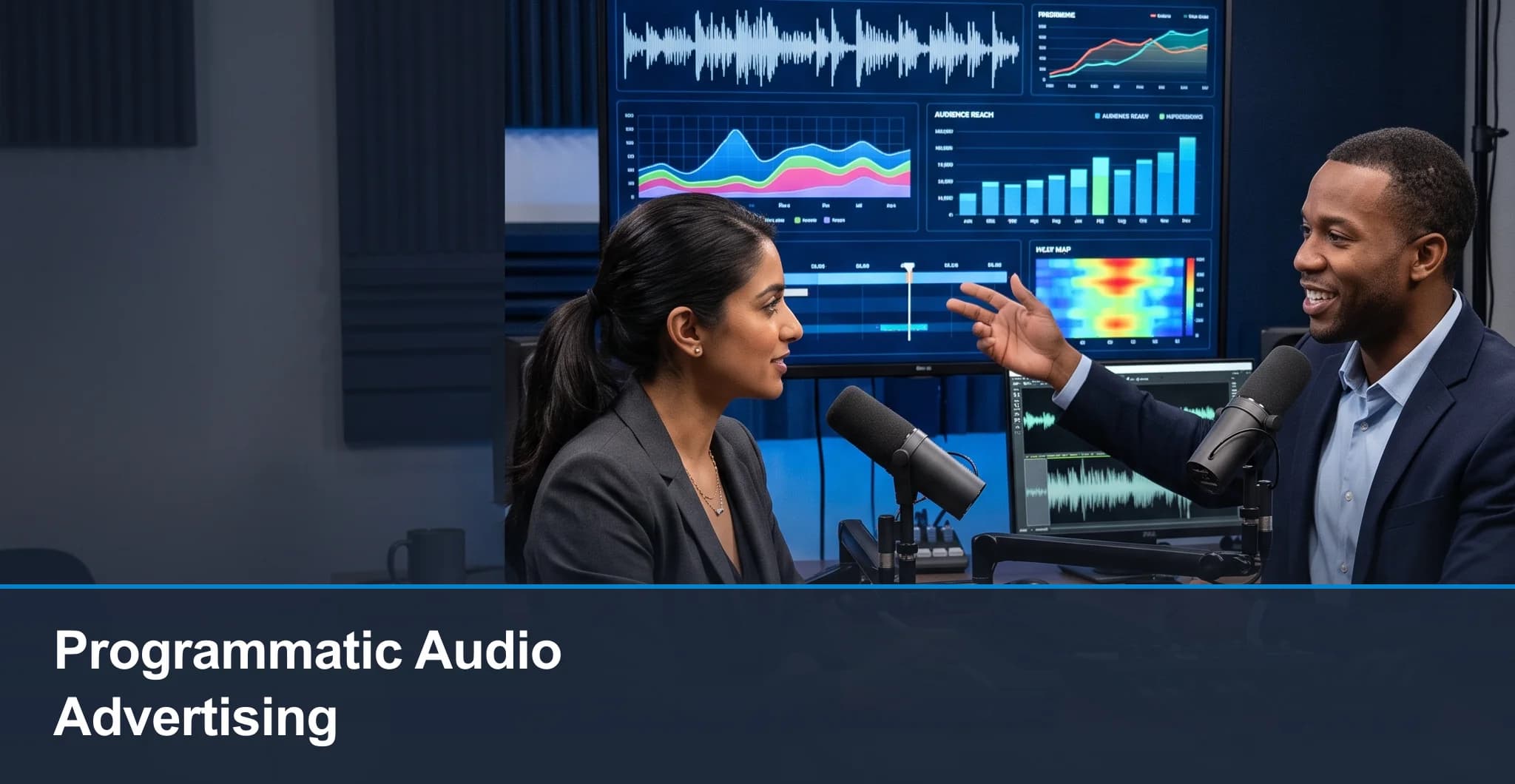
The digital audio market has matured fast, driven by dynamic ad insertion, programmatic guaranteed deals, and deep audience segmentation. This guide is for media buyers and advertisers who want to understand how programmatic audio inventory buying works, which formats are available, how targeting is structured, and why buying through private deals (PMP) is usually the better choice over open exchange.
We'll cover formats, distribution channels, open exchange vs. PMP, available targeting options, and how to launch a first audio campaign with a DSP.
What Is Programmatic Audio Advertising
Programmatic audio advertising is the automated buying of audio inventory, podcasts, music streaming, online radio, and audio apps, through DSPs and SSPs connected in real time. Unlike traditional radio media buying, based on manually negotiated packages and aggregated reporting, programmatic audio lets you evaluate every single listen based on context, device, and audience data, assigning the ad through an auction in milliseconds.
The reason it matters today is simple: listeners are often reachable during high-attention moments, while driving, working out, or working, when other visual formats can't reach them. Programmatic audio lets you capture these moments with scalable targeting and continuous optimization, instead of relying on fixed slots booked months in advance.
Audio Ad Formats
The main formats are pre-roll, mid-roll, and post-roll, spots inserted before, during, or after the audio content respectively, typically 15 to 30 seconds long. There are also native spots read directly by the podcast host and companion ads, static banners (300x250 or 728x90) shown on screen while the audio plays.
More advanced formats include interactive audio with voice calls-to-action or click-to-listen, and dynamic ad insertion (DAI), which inserts the most relevant ad in real time based on who's listening, even on an episode published months earlier.
On the technical side, every audio provider, Spotify, Soundcloud, Triton, AdsWizz, TargetSpot, requires specific compliance: accepted file formats (.mp3, .wav, .aac, .ogg), maximum file size, and maximum spot duration (typically 30 or 45 seconds). For a 30-second ad, a practical benchmark is 55-75 words of copy, with voice-over, background music, and sound effects balanced so the listen doesn't feel fatiguing.
For a deeper look at formats and the basic definition of audio ads, our audio advertising guide covers creative, KPIs, and use cases in more depth.
Where Audio Ads Run
Programmatic audio ads run across music streaming, podcasts, online radio, and audio apps on mobile and smart speakers. The supply side is anchored by a handful of audio-first platforms and SSPs that dominate global programmatic audio buying:
- Spotify: the largest music and podcast streaming platform, offering direct programmatic access to music and podcast audio inventory, plus dedicated PMP deals for music and video-audio formats.
- AdsWizz: one of the most widely used audio ad servers and SSPs, powering programmatic and Programmatic Guaranteed deals across podcast networks, streaming radio, and smart speaker inventory.
- Triton Digital: a leading audio-first SSP and ad server, specialized in streaming radio and podcast monetization with real-time bidding and dynamic ad insertion.
- Soundcloud: a major audio streaming platform offering programmatic inventory through supply-side partners, popular for reaching music-focused and younger audiences.
This landscape confirms that the digital audio market already has the scale and technical maturity to support structured programmatic campaigns, not just isolated tests.
Open Exchange vs. PMP: How to Buy Audio Inventory
Buying audio inventory programmatically means choosing between two main approaches: open exchange and private marketplace (PMP).
On the open exchange, inventory is available to anyone participating in the real-time auction: access is broad, but control over which specific publisher will show the ad is limited, and the risk of landing on low-quality or less brand-safe inventory is higher.
A PMP, by contrast, is a deal negotiated between a buyer and a specific publisher or SSP: inventory is reserved, CPM is agreed in advance, and the available targeting is defined within the deal itself. For programmatic audio, PMP is generally the preferred approach, because it guarantees certain editorial quality, predictable CPM, and a much lower risk of fraud or brand safety issues compared to the open exchange.
To understand what an audio PMP deal actually looks like, here's an illustrative example based on a generic catalog of premium audio inventory (indicative data, not specific to a single platform):
| SSP / Exchange | Deal Type | Indicative CPM | Example Publishers |
|---|---|---|---|
| Magnite DV+ | PMP Premium Audio | $3–$11 | Acast, Spreaker, Spotify |
| AdsWizz | PMP AdWave | from $6 | Nation Player, Sonos, Openstream |
| Google Ad Manager | PMP RON Audio | $4–$9 | Spotify Music, Azerion |
| Spotify | PMP Music & Podcasts | around $12 | Spotify: Music and Podcasts |
These figures are only meant to illustrate the typical structure of an audio PMP deal, with SSP, publisher, and agreed price range, and don't represent an official ad:personam rate card.
How Audio Ad Targeting Works
Audio targeting is built on several combinable layers: demographic, geolocation, dayparting (specific time slots based on listening behavior), and behavioral. Add to that contextual audio targeting, based on the type of content being listened to, and first- or third-party audience segments, including lookalike and device-type targeting.
Two techniques are essential to limit waste: frequency capping, which limits how many times the same user sees the same ad, and audience suppression, which excludes already-converted segments or recent customers from planning.
Why Use a DSP for Audio Advertising
Buying programmatic audio through a DSP means accessing multiple SSPs and audio-first sources through a single interface, instead of negotiating separately with each publisher. On ad:personam, the audio channel, available on the PRO plan, includes Spotify as a direct inventory source and curated PMP deals, within a network of over 330 sellers connected through Adform DSP. The network also includes audio-first SSPs like AdsWizz, Triton Digital, and AdTonos, plus audio inventory distributed via Magnite DV+.
Three concrete advantages of buying audio through a DSP instead of via manually managed open exchange:
- No minimum spend: test the audio channel with a modest budget before scaling.
- Access to premium inventory via PMP, without negotiating directly with each publisher.
- Real-time tracking and optimization, with the ability to integrate audio with display, video, and CTV for a consistent message across channels.
How to Get Started with ad:personam
To launch a first programmatic audio campaign, the practical path is: activate the PRO plan, set the campaign goal and budget, choose formats (pre-roll, mid-roll, companion), and define targeting on geo, dayparting, and audience. Before activating a subscription, you can explore available audio PMP deals and simulate coverage directly in Planning Mode, with no payment required.
Conclusion
Programmatic audio advertising combines the scale of digital audio with the precision of real-time targeting, and the publisher landscape already has the technical maturity to support it. Buying through PMP, rather than the open exchange, remains the most effective choice to guarantee inventory quality and predictable CPM.
Discover how to activate the audio channel with ad:personam, with no minimum spend and direct access to Spotify and audio PMP deals.
You might also like
Rich Media Ads: What They Are & How They Work
Rich media ads are interactive, expandable, animated—not static banners. See formats, use cases & benefits, then build yours with the AI Banner Generator.
OTT Platforms: Complete Guide to Advertising, CTV, and Streaming Services
Comprehensive guide to OTT platforms: how streaming services work, differences with CTV, and why they matter in programmatic advertising.
Audio Advertising: Complete Guide to Programmatic Audio & Podcast Ads
Discover what audio ads are, explore high-definition audio ad formats, and learn how to create effective digital audio campaigns with programmatic DSP and AI-driven optimization.