
OTT Platforms: Complete Guide to Advertising, CTV, and Streaming Services
Comprehensive guide to OTT platforms: how streaming services work, differences with CTV, and why they matter in programmatic advertising.
Contents
- OTT vs CTV: Definitions and Differences
- Types of OTT Platforms and Service Models
- Formats and Creatives for OTT/CTV Advertising
- Advanced Targeting on OTT Platforms
- Programmatic and Real-Time Bidding on OTT Platforms
- How OTT Platforms Generate Revenue
- Key Metrics for OTT and CTV Campaigns
- Technologies and Integrations for OTT Platforms
- UX and Ad Experience Impact on OTT
- Challenges of OTT and CTV Advertising
- How to Choose the Right OTT Platform
- Overview of Major OTT and CTV Platforms
- Advertiser Strategies on OTT/CTV
- Privacy, Consent, and Regulations for OTT
- Emerging Trends and the Future of OTT Platforms
- FAQ on OTT Platforms
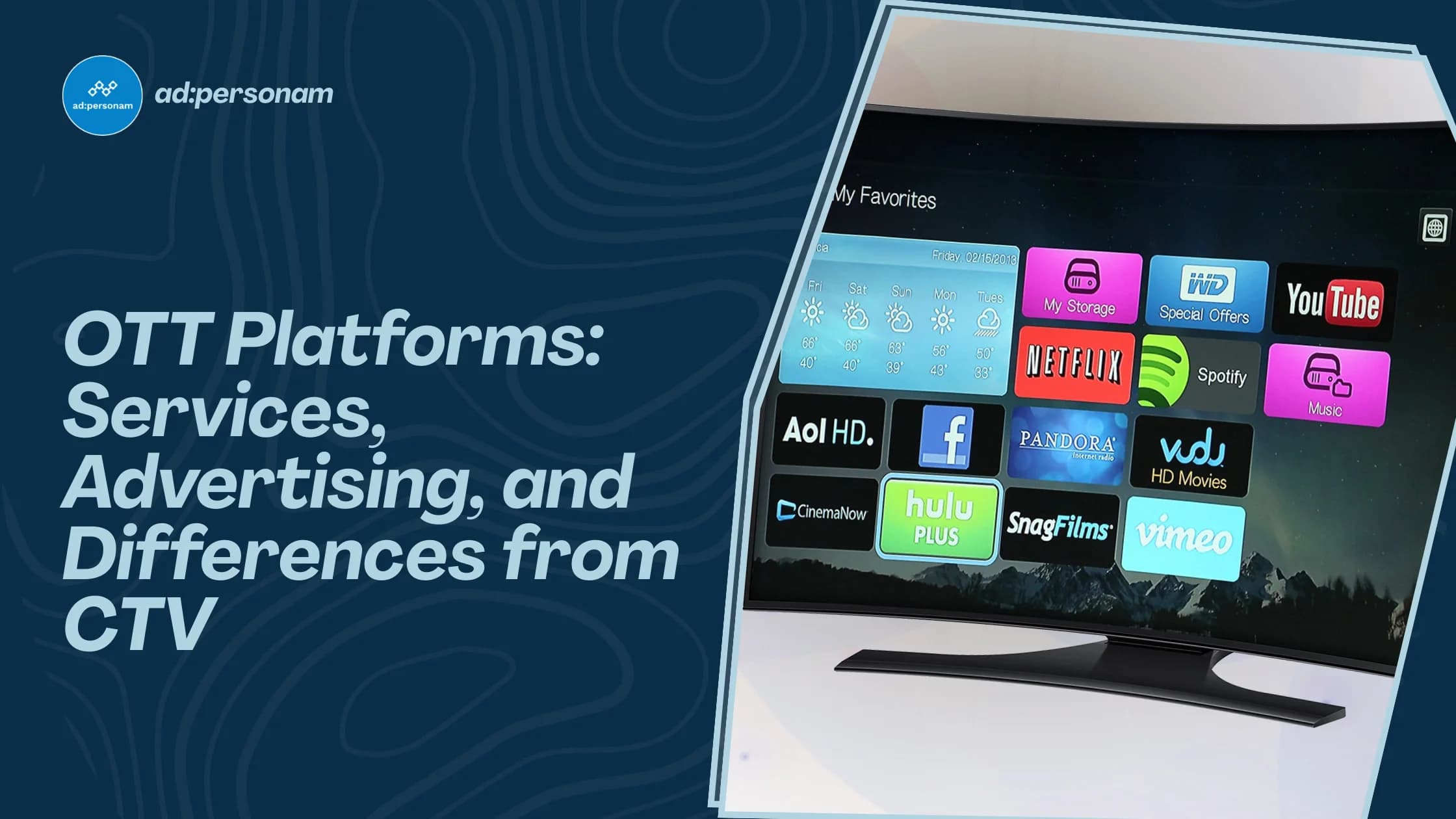
OTT platforms, short for Over-The-Top, represent all services that distribute video content over the Internet without requiring traditional broadcaster infrastructure or cable operators. In recent years, the growth of streaming platforms has radically transformed media consumption behaviors.
The rise of connected TV (CTV) and broadband connections has enabled simpler, more personalized access to content. For brands and media agencies, this landscape opens new communication and monetization opportunities through advertising formats that are more measurable and targetable than traditional television.
In this complete guide, we'll explore the differences between OTT and CTV, the most common business models, and how to maximize the advertising potential of video streaming.
OTT vs CTV: Definitions and Differences
The term CTV (Connected TV) refers to any television connected to the Internet, capable of playing content from OTT platforms through apps or external devices like Amazon Fire Stick, Roku, or Apple TV.
While OTT refers to content and distribution model, CTV concerns the viewing device—the physical hardware. In many cases, these categories overlap but don't completely coincide: a video watched on YouTube's mobile app is OTT, not CTV; the same viewing on a home screen falls into both categories.
OTT platforms offer advantages such as freedom of choice, accessibility, and on-demand viewing for users. For advertisers, they represent an opportunity to leverage interactive formats and granular data. Unlike linear TV, the experience is highly personalized and measurable, with the ability to track performance and optimize campaigns in real time.
Types of OTT Platforms and Service Models
OTT platforms are distinguished by their monetization model.
The SVOD system (Subscription Video On Demand) is based on monthly subscriptions, as with Netflix or Disney+. The AVOD model (Advertising Video On Demand) provides free access to content but includes advertising, like YouTube or Pluto TV. In the TVOD or pay-per-view model, users pay only for content they choose, a solution common on Apple TV or Rakuten.
In recent years, the FAST format (Free Ad-Supported Streaming TV) has also emerged, combining free service with the linearity of themed streaming channels. Finally, there are marketplaces or white-label platforms that allow publishers and broadcasters to create their own customized OTT offering, with direct control over content, data, and advertising inventory.
Formats and Creatives for OTT/CTV Advertising
Video advertising on OTT/CTV platforms includes various formats: pre-roll, mid-roll, or post-roll ads, brief 6-second clips (bumper ads), overlays, and companion banners that enrich the viewing experience.
To succeed, creative must maintain high quality and adapt to the television context. Short but impactful videos with clear storytelling and high-definition production generally achieve higher completion rates. Optimizing audio and considering the mute experience—common on CTVs—is essential, as is ensuring compatibility with technical standards like VAST, VPAID, and VMAP, which are fundamental for ad delivery and proper metric tracking.
Advanced Targeting on OTT Platforms
OTT platforms enable far more precise targeting techniques than traditional TV. Advertisers can combine segments based on context, behavior, demographics, location, or time slots.
Deterministic targeting, based on user login or account, provides high accuracy; probabilistic targeting uses predictive models to estimate interests or characteristics based on device. Both benefit from cookieless solutions, increasingly relevant for privacy compliance and regulations.
Using custom segments and lookalikes allows you to expand reach while maintaining consistency with the target audience, improving performance during the conversion phase.
Programmatic and Real-Time Bidding on OTT Platforms
Programmatic advertising applied to OTT leverages an ecosystem composed of DSP (Demand-Side Platform), SSP (Supply-Side Platform), and ad exchanges to automate ad space purchases.
This model enables greater scalability, real-time optimizations, and exposure frequency control. For advertisers and publishers, it ensures efficiency through the ability to measure every impression and monitor performance per creative. However, technical challenges remain related to latency management, video feed alignment, and inventory quality, which can vary between open markets and premium environments.
Enhance your OTT platform campaigns with our Self-Service DSP ad:personam, perfect for small and medium businesses!
How OTT Platforms Generate Revenue
Primary revenue sources are divided among advertising, subscriptions, pay-per-view, sponsorships, and hybrid models. Optimizing revenue involves yield management strategies and solutions like CTV-specific header bidding, which increases competition among advertisers.
The most relevant KPIs for publishers include eCPM, fill rate, ARPU, and viewability rate: essential parameters for evaluating business model effectiveness and sustainability.
Key Metrics for OTT and CTV Campaigns
Measuring advertising performance on OTT requires dedicated indicators. Primary metrics include completion rate (percentage of complete views), viewability, completion quartiles, reach, frequency, VTR, and CPM.
Compared to web video advertising, CTV analysis focuses more on viewing quality and brand impact. Consistent and comparable reports enable budget optimization across digital channels, while brand safety and fraud detection systems ensure transparency and protection against invalid traffic or bots.
Technologies and Integrations for OTT Platforms
An efficient OTT ecosystem is built on integrated technical components: video players, CDNs for distribution, ad servers, Server-Side Ad Insertion (SSAI) or Dynamic Ad Insertion (DAI) systems, DRM for content protection, and analytics tools.
Choosing the ideal platform must consider compatibility with advertising protocols, API availability for reporting, and support for major DSPs and SSPs in the market. Thorough testing before launch ensures a smooth user experience and reliable data for advertisers.
UX and Ad Experience Impact on OTT
User experience is a crucial element in OTT strategy success. Overly invasive or repetitive ads can reduce engagement and compromise results.
Limiting frequency, balancing ad duration, and maintaining consistency with editorial content foster a positive experience. In CTV formats, visual impact is maximized: messages must be clear, memorable, and designed for collective viewing, often in home settings.
Challenges of OTT and CTV Advertising
The main challenges in OTT and CTV advertising are fragmented measurement and lack of shared standards across platforms, making cross-device comparison complex. Misleading advertising and limited access to granular data in certain markets are risk factors.
These are compounded by high production costs for creative assets and regulatory constraints from GDPR and consent management.
How to Choose the Right OTT Platform
Identifying the most suitable platform depends on several criteria: audience size, supported format types, level of integration with advertising tools, ad serving costs, and analytical report completeness.
It's advisable to evaluate revenue share models, compatibility with SSAI and DAI, technical support, and availability of customizable APIs.
Overview of Major OTT and CTV Platforms
The market divides between major global streaming players, distribution platforms for publishers, white-label solutions, and specialized ad tech providers. Large operators offer scale and reach but leave less data control; proprietary platforms provide autonomy and higher margins, requiring greater technical investments. Ad tech specialists serve as meeting points, providing flexible advertising infrastructure and advanced measurement solutions.
Advertiser Strategies on OTT/CTV
To maximize campaign performance, advertisers must combine awareness and performance strategies. A/B tests on formats help identify the most effective creative, while cross-device integration allows tracking user journeys across multiple screens.
Incremental measurement estimates real conversion impact beyond simple visibility metrics. Proper budget allocation between branding and direct response campaigns represents the key to balanced and sustainable planning.
Privacy, Consent, and Regulations for OTT
OTT is subject to GDPR rules and personal data protection regulations. Platforms must ensure transparent consent management, especially in login-based contexts or where user identification occurs deterministically.
With the advent of cookieless solutions, adopting clear policies, updated documentation, and systems that respect user preferences expressed during opt-in becomes essential.
Emerging Trends and the Future of OTT Platforms
In coming years, the OTT market will evolve toward greater ability to target content to specific audiences even without cookies and an increase in FAST channels supported by dynamic advertising. CTV growth, AI use for creative personalization, and cross-device measurement will define the new frontier of video advertising.
FAQ on OTT Platforms
Question 1: What are OTT channels?
OTT channels are streaming services that transmit content via the Internet, bypassing television and cable operators. They offer movies, series, and programs accessible anywhere, anytime. For digital marketing, they represent a powerful medium to reach profiled audiences with dynamic, measurable video formats.
Question 2: What does OTT mean?
The acronym OTT (Over-The-Top) indicates all services that distribute multimedia content via the Internet. In advertising, they enable companies to plan targeted, personalized ads on a per-user basis, leveraging consumption data and artificial intelligence techniques to optimize performance.
Question 3: What does OTT mean in digital?
In the digital context, OTT describes direct content distribution through the network, without television intermediaries. This approach enables new forms of digital advertising that combine visual power and targeting precision, ensuring greater efficiency and budget control.
OTT platforms are the future of video distribution and data-driven advertising.
By signing up for ad:personam, you can start managing your OTT campaigns independently.
You might also like
Programmatic Audio Advertising: A Complete Guide for Advertisers
Learn how programmatic audio advertising works: formats, targeting, open exchange vs. PMP, and how to launch a campaign with ad:personam.
AI in Programmatic Advertising: What Works in 2026
Learn how AI improves programmatic planning, optimisation, reporting, creative workflows, and agentic execution, with practical examples for 2026.

Sports Marketing Revolution: How Programmatic Advertising Is Changing the Game
Discover how programmatic advertising is transforming sports marketing — from real-time fan targeting to measurable ROAS across display, CTV, and audio.