
Programmatic Advertising and AI in 2026: A Guide for SMBs and Agencies
See how AI is reshaping programmatic ad spend in 2026, and why a self-serve DSP with no minimum spend is finally opening the market to SMBs and agencies.
Contents
- The Global Ad Market in 2026 and the AI Push
- From Big Agencies to New Players: AI Redefines Media Planning and Buying
- The Historical Barriers to Programmatic Advertising for SMBs and Independent Agencies
- The ad:personam Angle — How AI and Self-Serve Are Democratizing Programmatic
- Practical Strategies for Capturing the AI Opportunity in Digital Campaigns
- Conclusion
- Frequently Asked Questions
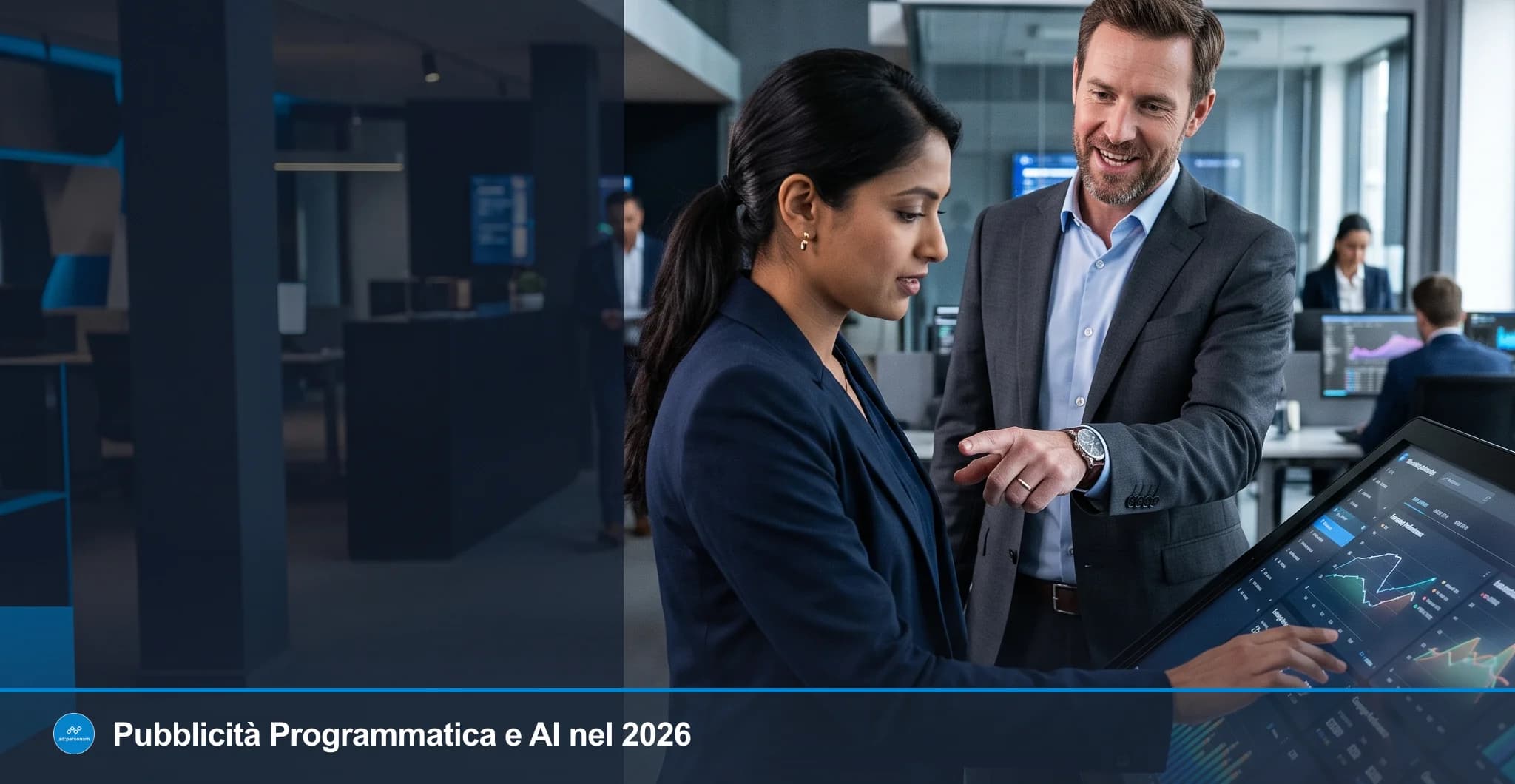
2026 marks a turning point for programmatic advertising: according to the Warc study reported by Engage, global ad spend will grow by 11.9%, driven largely by the adoption of artificial intelligence across the entire media value chain.
The landscape is shifting fast on multiple fronts. On one side, conversational ad platforms like ChatGPT Ads are redefining how people discover brands and products. On the other, major media groups are reinforcing their tech stacks: WPP expanded its partnership with Kyndryl specifically to accelerate AI adoption across planning and delivery.
The thesis of this article is simple: artificial intelligence is pairing analytical efficiency with operational simplicity, and that combination is making AI-powered programmatic advertising accessible not just to large corporations, but to SMBs, startups, and independent agencies that couldn't afford an enterprise DSP until now.
The Global Ad Market in 2026 and the AI Push
The 11.9% growth figure from Warc isn't an isolated data point — it reflects a structural shift in how ad budgets get allocated and optimized. Over the past two years, advertisers have moved spend toward channels and processes where AI can intervene directly in media-buying decisions, from real-time auctions all the way through to creative production.
The mechanism is concrete: machine learning algorithms analyze behavioral, contextual, and historical performance signals to automatically optimize real-time auctions, adjusting bids and budget pacing without manual intervention from a trader. The result is better campaign performance at the same spend level, because human error on repetitive decisions — thousands of auctions per second — is drastically reduced.
This technological push comes alongside growing channel diversification. Display and video remain the pillars of programmatic spend, but Connected TV (CTV) and programmatic audio are capturing a growing share of budgets as content consumption shifts toward streaming and podcasts. For an agency or an SMB, this means that "doing programmatic" in 2026 no longer means picking a single channel — it means orchestrating display, video, CTV, and audio within the same strategy, with AI distributing budget to wherever it performs best.
From Big Agencies to New Players: AI Redefines Media Planning and Buying
The arrival of platforms like ChatGPT Ads in the advertising ecosystem signals something deeper than just a new channel: generative AI is also entering the discovery phase — the moment a user finds a product — not just ad delivery. To dig deeper into how AI tools are changing every stage of the campaign lifecycle, it's worth reading about the role of AI in programmatic advertising.
The most tangible shift, though, is the move from complex, manual planning to strategies driven by predictive and generative models. Just a few years ago, building a media plan meant days of spreadsheet analysis, cross-referencing demographic data, and reach estimates based on a trader's gut feel. Today, an AI model can generate a proposal — channels, budget, expected KPIs — in seconds, starting from a simple natural-language brief.
This automation has a direct effect on cost: it reduces the intermediation needed to launch a campaign. Fewer manual steps mean fewer billable hours from a specialized trader, less back-and-forth with an account manager, and therefore lower management fees for anyone — a small agency or an SMB — who can't afford an in-house team dedicated to programmatic advertising.
The Historical Barriers to Programmatic Advertising for SMBs and Independent Agencies
Despite its potential, programmatic advertising has stayed, for years, a space reserved for large advertisers and structured agencies. The reason comes down to the typical constraints of enterprise DSPs (Demand-Side Platforms): monthly minimum spend requirements often in the thousands of euros, rigid annual contracts, and management fees stacked on top of actual media cost.
On top of that come real operational challenges. An SMB or independent agency rarely has an in-house team dedicated to managing programmatic, with expertise in targeting, bidding, and reporting. The complexity of reading reporting data — often scattered across multiple dashboards and formats — discourages adoption even when the ad budget would otherwise be there.
Finally, there's the question of inventory access. Premium publishers typically negotiate direct deals with large media groups, leaving SMBs with only two options: go through costly intermediaries, or settle for lower-quality inventory on the open exchange. Neither is a genuinely sustainable solution for anyone managing a modest budget.
The ad:personam Angle — How AI and Self-Serve Are Democratizing Programmatic
ad:personam is a self-serve B2B DSP built on the Adform DSP APIs, designed specifically to remove the access barriers described above. The first distinctive feature is the complete absence of any minimum spend requirement: you can launch a campaign with the budget you actually have, not the one dictated by an enterprise contract.
Alongside that is Planning Mode, which lets anyone sign up and plan campaigns for free before ever activating a subscription. In Planning Mode you can generate strategies with the AI Media Planner, create creative previews, simulate estimated reach, and browse available inventory — all without any payment required.
AI tools are built directly into the day-to-day workflow:
- AI Media Planner: generates tailored strategies from a natural-language description of your goal, with specialized assistants for programmatic, LinkedIn Ads, and Google Ads campaigns.
- Banner Generator: creates professional display creatives in 5 IAB formats (from mobile banner to billboard) starting from nothing more than a company URL, extracting brand colors and tone of voice.
- AI reporting suite: includes Insight Agent for guided analysis with conversational follow-up across 7 report types (campaign, creative, domain, audience, supply, geo, device), complete with narrative summaries ready to share with stakeholders, and Query Agent for ad-hoc natural-language queries that return SQL, a data table, and a written answer.
Rounding out the picture is inventory quality: direct access to more than 330 publisher sources and 30+ global ad exchanges through Adform DSP, with full transparency into where campaigns actually run.
Practical Strategies for Capturing the AI Opportunity in Digital Campaigns
The first practical step is building truly omnichannel campaigns: display, video, CTV, audio, and in-app, all managed independently from the same interface, without juggling different vendors for every channel. The AI Media Planner helps exactly here, suggesting a budget split that's consistent with your stated objective (awareness, leads, sales) instead of leaving the decision to gut instinct.
The second step is targeting in an increasingly cookieless world. ad:personam offers two complementary approaches: contextual targeting powered by Semasio, which places ads next to relevant content by analyzing page text in real time, and IAB Digiseg segments, which let you reach households based on traits like income, number of children, or home type — with zero reliance on third-party cookies.
The third step is continuous ROAS monitoring. Instead of waiting for a monthly report from an external agency, Insight Agent and Query Agent let you query campaign data in natural language, getting answers based on automatically generated, transparent SQL queries you can verify at any time — not just at the end of the reporting period.
Conclusion
Artificial intelligence is closing the gap that, for years, separated big advertisers from small and mid-sized businesses. Warc's 11.9% global growth figure, the arrival of platforms like ChatGPT Ads, and infrastructure investments from groups like WPP all confirm that AI is now the industry's main engine — not just a nice-to-have feature.
For an SMB or independent agency, that means the time to get into programmatic advertising with the right tools is now. Explore ad:personam's Planning Mode for free or start your 30-day free trial to launch your first programmatic campaign with the AI Media Planner's support.
Frequently Asked Questions
How is AI changing ad spend in 2026?
According to Warc's study, global ad spend will grow 11.9% in 2026, with AI as the main driver: automatic bid optimization, predictive planning, and new conversational ad platforms are making every euro spent more efficient.
What are the benefits of a self-serve DSP for an SMB or agency?
A self-serve DSP like ad:personam removes the need for external trading-desk intermediaries, lowers management fees, and lets you directly control targeting, budget, and reporting — while keeping the same inventory quality as large enterprise platforms.
Can you run programmatic advertising without a minimum spend?
Yes. ad:personam has no minimum spend requirement and offers a free Planning Mode that lets you plan and simulate campaigns before subscribing, plus a 30-day free trial to test the platform with real campaigns.
How does ad:personam's AI Media Planner work?
Just describe your campaign goal in natural language — channel, target audience, budget — and the AI Media Planner generates a complete strategy in seconds, with budget allocation, recommended channels, and expected KPIs, backed by specialized assistants for programmatic, LinkedIn Ads, and Google Ads.
You might also like
Programmatic DOOH Advertising: A Complete Guide for Advertisers
Learn how programmatic DOOH advertising works: buying models, creative specs, formats, targeting, and measurement, plus how to launch on ad:personam.
Programmatic OOH Advertising: Complete Guide (OOH + DOOH)
See how self-serve programmatic OOH works: buy static, digital, and transit outdoor inventory automatically, beyond traditional outdoor buying.
Inclusive Marketing: How Programmatic Advertising Makes Ads for Everyone
Discover what inclusive marketing is, why it matters, and how programmatic advertising helps brands build authentic, accessible, and effective campaigns for diverse audiences.