
Programmatic DOOH Advertising: A Complete Guide for Advertisers
Learn how programmatic DOOH advertising works: buying models, creative specs, formats, targeting, and measurement, plus how to launch on ad:personam.
Contents
- What Is Programmatic DOOH Advertising
- DOOH vs OOH: What's Different and Why It Matters for Programmatic Buyers
- How Programmatic DOOH Buying Works
- DOOH Creative Specifications: What You Need to Know Before You Upload
- DOOH Formats and Environments
- Targeting Options for Programmatic DOOH
- Measuring Programmatic DOOH Campaign Performance
- How to Launch Programmatic DOOH Campaigns with ad:personam
- FAQ on Programmatic DOOH Advertising
- Conclusion
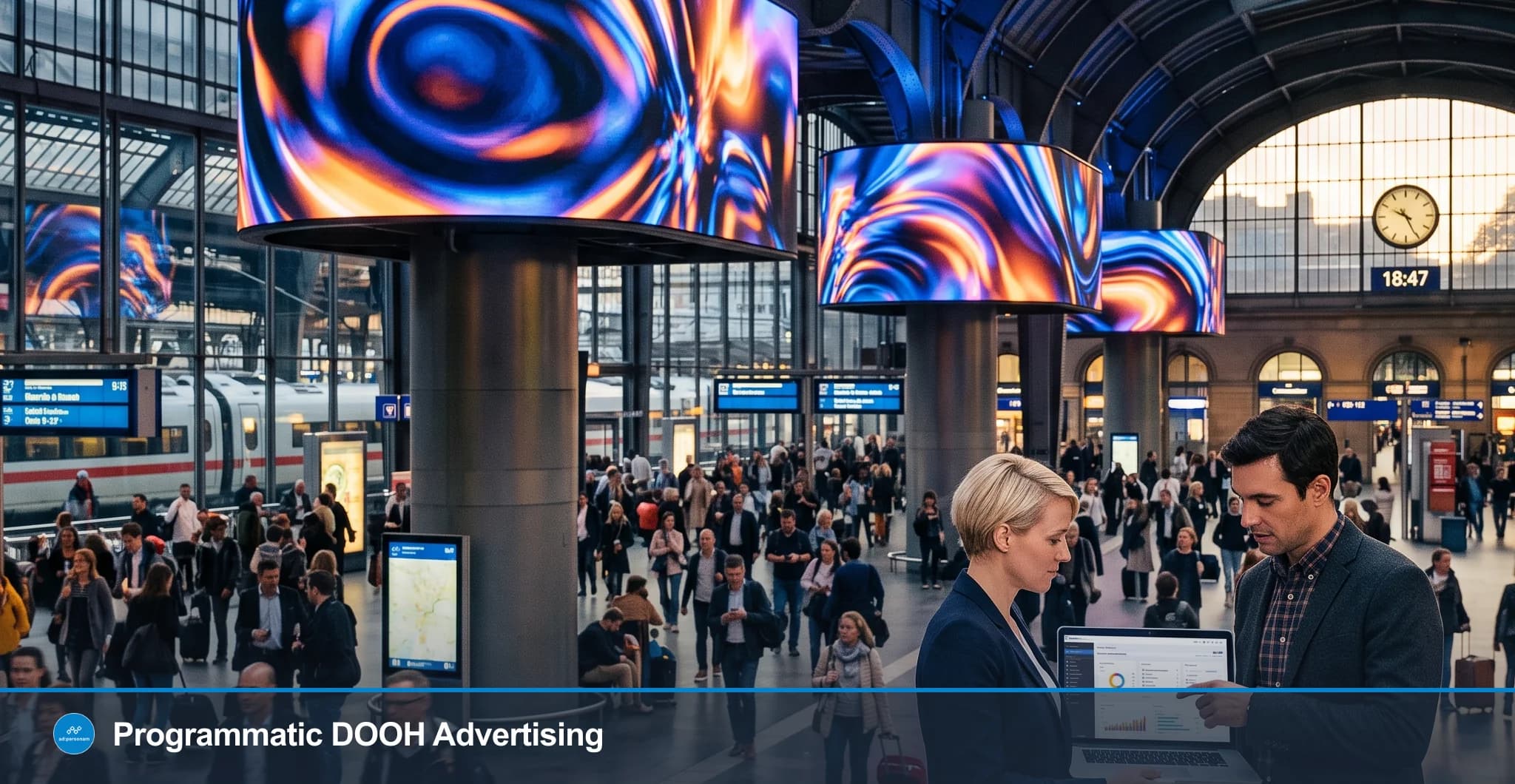
Programmatic DOOH advertising is the automated buying of digital out-of-home screens, billboards, transit panels, retail and airport displays, through DSPs and SSPs connected in real time. Instead of booking a fixed weekly slot on a specific screen, you buy audiences and moments: a defined budget, a targeting logic, and a creative that can update dynamically based on location, time, or context.
The shift is already measurable in Italy, one of ad:personam's core markets. According to the Osservatorio Internet Media of Politecnico di Milano, the Italian OOH market reached €766 million in 2025 (+8% year on year), and Digital Out of Home alone generated 82% of that growth, rising to €273 million (+21%) and now representing 36% of the total OOH market. Within DOOH, the programmatic segment is still small but growing fast: €15.2 million in 2025, up 27% year on year.
This guide covers how programmatic DOOH buying actually works, the creative specifications you need before you upload a single asset, the formats and premium inventory available across Europe, targeting options, measurement, and how to launch a campaign with a self-serve DSP.
What Is Programmatic DOOH Advertising
Programmatic DOOH (Digital Out of Home) is the use of automated, data-connected buying to purchase and optimize digital out-of-home screens, as opposed to negotiating a fixed placement manually with a media owner. The "programmatic" part means the buy runs through a DSP and one or more supply-side platforms (SSPs), with budget, targeting, and creative delivery managed centrally rather than screen by screen.
It sits above traditional OOH (static posters, vinyl, non-digital formats) and below Smart OOH (SOOH), which layers in real-time personalization, augmented reality, and interactive triggers such as QR codes or gesture recognition. Programmatic DOOH is the layer most advertisers actually buy today: digital screens, bought automatically, with data-driven targeting.
DOOH vs OOH: What's Different and Why It Matters for Programmatic Buyers
The practical difference between traditional OOH and programmatic DOOH comes down to how fast you can move and how precisely you can target:
| Feature | Traditional OOH | Programmatic DOOH |
|---|---|---|
| Buying cycles | Weekly or bi-weekly, fixed | Hourly, real-time |
| Operational agility | Static, long lead times | Flexible, real-time triggers |
| Creative format | Static paper or vinyl | Video, dynamic, interactive |
| Targeting | Geographic placement only | Data-driven (weather, time, POI) |
The underlying shift is from buying space to buying audiences. A traditional OOH buy reserves a physical location for weeks; a programmatic DOOH buy reserves exposure to a defined audience at a defined moment, and can be adjusted or paused far faster than a paper campaign ever could.
How Programmatic DOOH Buying Works
Programmatic DOOH is typically bought through one of three models: Programmatic Guaranteed (PG), where specific screens or slots are reserved in advance at a fixed price; Private Marketplace (PMP) deals, negotiated directly with a media owner or SSP for premium or high-impact inventory; and open auction, a smaller pool of inventory bought in real time without a negotiated deal. Premium, high-visibility screens are usually sold through PG or PMP rather than open auction.
Budgeting and measurement also work differently than on standard web display. DOOH campaigns are generally budgeted and evaluated against eCPM and Opportunity-to-See (OTS), not raw ad-play counts, because a single screen impression represents estimated audience reach rather than one individually tracked view.
DOOH is also inherently non-personal and cookieless: a public screen shows the same creative to everyone in view, so there's no persistent device or user identifier to target or exclude. That has a direct practical consequence many advertisers overlook: standard frequency capping doesn't work the same way it does on display or video. Since there's no individual to cap exposure against, how often a spot repeats is effectively controlled by the screen's own rotation loop, managed by the media owner or SSP, rather than by a per-user frequency limit set at the campaign level.
Finally, creative approval on DOOH tends to be slower than on standard web inventory. Because assets are often pre-cached directly on media-owner hardware rather than served dynamically, a review window of around 48 hours before a creative goes live is common. Some suppliers offer faster automated checks, but manual verification is still standard practice on high-impact, premium placements.
DOOH Creative Specifications: What You Need to Know Before You Upload
DOOH creative compliance is a pass/fail gate, not a suggestion. A file that doesn't meet the network's technical requirements won't just render poorly, it will typically be rejected outright before it ever reaches a screen. The baseline specifications that apply across most networks are:
- Dimensions: 1080×1920 (portrait) and 1920×1080 (landscape).
- Encoding: MP4 format, H.264 encoding, 25 fps, 8 Mbit/s bit rate, RGB color space.
- Duration: 5 to 30 seconds.
Static image assets are accepted only by a small number of premium suppliers. Everywhere else, static creative needs to be converted into a short video file before it can run, which is a common source of delay for teams uploading a display banner and expecting it to work as-is.
For creative that actually performs, keep messaging short and legible from a distance, favor motion to capture attention in a busy environment, and lean on a simple call-to-action such as a QR code or short link, since DOOH has no native click-through the way web display does.
DOOH Formats and Environments
DOOH inventory spans several distinct environments, each suited to a different moment in the funnel: large-format digital billboards and spectaculars for broad awareness, transit and rail networks for high-frequency commuter reach, retail and mall screens for proximity to purchase decisions, airport networks for a captive, high-dwell-time audience, and always-on roadside screens for general market coverage.
Premium DOOH inventory across Europe. ad:personam's Adform-powered supply reaches named, premium media owners across ad:personam's core markets. In Italy, that includes Grandi Stazioni Retail (major rail stations), IGPDecaux (subway and airport networks in Milan, Rome, and Naples), Mediamond, Urban Vision, and Klepierre shopping malls. Across the DACH region, supply includes Ströer, Wall Decaux, Gewista, and APG|SGA. In the UK, it includes Clear Channel UK, JCDecaux UK, and Ocean Outdoor. This is part of the same 330+ inventory sources available across ad:personam's other channels, accessible through the display advertising platform.
Targeting Options for Programmatic DOOH
DOOH targeting is built around where, when, and under what conditions a screen is seen, rather than who is looking at it individually. Location and point-of-interest proximity let you concentrate spend near relevant venues, dayparting adjusts delivery to match footfall patterns by time of day, and weather-triggered creative lets a message adapt automatically to real-world conditions, a natural fit with ad:personam's Weather Targeting feature, which already supports display, video, and CTV.
Footfall and mobile-location data add a further proximity signal, helping identify which screens sit closest to relevant audience movement. As covered above, this all happens without individual identifiers: DOOH targeting works at the level of place, time, and condition, which keeps it inherently privacy-forward compared to identity-based targeting on other channels.
Measuring Programmatic DOOH Campaign Performance
The primary KPI for DOOH is eCPM against Opportunity-to-See, not clicks, so it's worth setting that expectation early: DOOH won't benchmark against display CTR, and shouldn't be judged by that standard. Footfall attribution and mobile-location data are the standard methods for measuring incrementality, showing whether exposure to a screen correlates with a subsequent visit. QR codes and short links add a lightweight, direct interaction layer on top of that. For awareness-stage campaigns, brand-lift studies remain the most common way to quantify recall and message association.
How to Launch Programmatic DOOH Campaigns with ad:personam
DOOH on ad:personam runs through the same self-serve platform as display, video, CTV, and audio, with no minimum spend required to get started. That means a small business or agency testing DOOH for the first time doesn't need a separate enterprise contract to access premium inventory, and can plan alongside every other channel from one dashboard, with AI-assisted optimization and reporting throughout.
In practice, launching a first programmatic DOOH campaign follows four steps: identify the premium inventory relevant to your audience and market, set budget, targeting, and flight dates, upload creative that meets the technical specifications above, then launch and monitor delivery and performance from the same reporting tools used for your other channels. Teams new to programmatic buying more broadly can start with programmatic advertising for small business to see how the no-minimum-spend model works across channels before adding DOOH to the mix.
FAQ on Programmatic DOOH Advertising
What is programmatic DOOH advertising?
Programmatic DOOH is the automated buying of digital out-of-home screens, billboards, transit panels, retail and airport displays, through a DSP connected to one or more supply-side platforms, rather than negotiating each placement manually with a media owner.
What's the difference between OOH and DOOH?
OOH is the umbrella category for all out-of-home advertising, including static, non-digital formats like paper posters. DOOH refers specifically to the digital, screen-based subset of OOH, which can be updated in real time and bought programmatically.
Is there a minimum spend to run DOOH campaigns?
Not on ad:personam. DOOH runs through the same self-serve, no-minimum-spend platform used for display, video, CTV, and audio, so it can be tested with a modest budget before scaling.
How is DOOH advertising measured if there are no clicks?
DOOH is typically measured against eCPM and Opportunity-to-See rather than clicks, with footfall attribution, mobile-location data, and brand-lift studies used to evaluate incrementality and awareness impact.
Conclusion
Programmatic DOOH turns out-of-home from a fixed, weekly-booked medium into a flexible, audience-based channel, and the Italian market data shows just how fast that shift is happening. Getting it right means respecting DOOH's specific buying logic, creative requirements, and measurement approach, rather than treating it as just another display placement.
See how ad:personam powers programmatic DOOH and display campaigns →
You might also like
Programmatic OOH Advertising: Complete Guide (OOH + DOOH)
See how self-serve programmatic OOH works: buy static, digital, and transit outdoor inventory automatically, beyond traditional outdoor buying.
Inclusive Marketing: How Programmatic Advertising Makes Ads for Everyone
Discover what inclusive marketing is, why it matters, and how programmatic advertising helps brands build authentic, accessible, and effective campaigns for diverse audiences.

Sports Marketing Revolution: How Programmatic Advertising Is Changing the Game
Discover how programmatic advertising is transforming sports marketing — from real-time fan targeting to measurable ROAS across display, CTV, and audio.